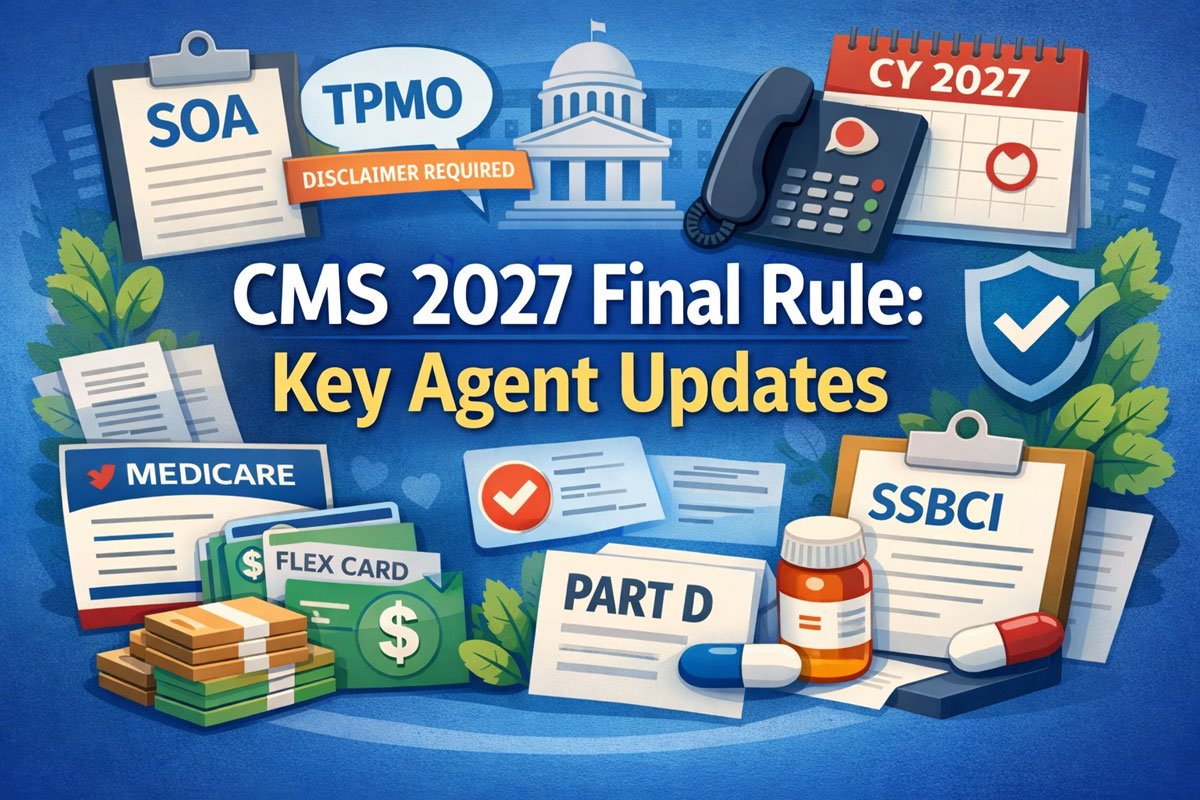
CMS 2027 Final Rule: Key Agent Updates
Big changes are here for Contract Year 2027, and they’re a mix of more flexibility and stronger expectations. The goal is to reduce unnecessary friction for beneficiaries and agents, while still keeping marketing and enrollment compliant.
Important timeline to know
- The rule is effective June 1, 2026 and generally applicable for coverage beginning January 1, 2027.
- CMS notes that marketing and communications policies apply starting October 1, 2026 (the start of the 2027 marketing season).
What changed (quick list)
Here are the updates most Medicare agents will feel right away:
- SOA 48-hour wait is gone (SOA still required).
- More “SOA-like” requests now qualify (BRCs, voicemails, online forms, etc.).
- TPMO disclaimer timing is more flexible (must be said before benefits discussion).
- Educational + marketing event timing is easier (no 12-hour gap, but you must notify and allow people to leave).
- Call recording retention is lighter (6 years total; audio first 3 years; audio or transcript years 4–6).
- More oversight on supplemental benefits marketing (especially debit/flex-card style benefits).
- SSBCI transparency increases (plans must publicly post eligibility criteria).
- Part D IRA changes are codified for 2027+ (coverage gap eliminated, reduced annual OOP threshold, Manufacturer Discount Program codified, etc.).
1) SOA timing flexibility
(the 48-hour wait is eliminated)
What changed:
CMS finalized the removal of the 48-hour waiting period between completing an SOA and having a personal marketing appointment.
What did NOT change:
- SOAs are still required. CMS is not eliminating the SOA requirement.
- For in-person personal marketing appointments, the SOA must be in writing.
What to do now (agent best practice):
- Treat the SOA like a “gate.” Complete and document it before any plan-specific discussion starts.
- Tighten your scripting: confirm scope, document it, then move into benefits.
2) Clarified qualifying SOAs
(more requests count)
CMS clarified that certain requests for information are “in effect” SOAs—when they include the type of product(s) to be discussed.
Examples include:
- Business Reply Cards (BRCs)
- Voicemails
- Online forms / internet request forms
- Other requests that specify the product type(s)
What to do now:
- Update your intake process so these items are captured, stored, and easy to retrieve during an audit.
3) TPMO disclaimer updates
(timing change)
What changed:
The TPMO disclaimer is no longer required “within the first minute.” Instead, it must be delivered prior to discussing any benefits.
What to do now:
- Move your disclaimer to the moment right before you switch into plan benefits.
- Train your team to avoid “benefit leakage” before the disclaimer.
4) Event rules eased
(educational + marketing)
What changed:
CMS eliminated the 12-hour delay requirement so a marketing event can take place directly following an educational event in the same location—as long as you:
- clearly notify attendees the educational event is ending and a marketing event will begin, and
- give attendees a sufficient opportunity to leave before marketing begins.
What to do now:
- Add a clear “break + reset” step to your event script.
- Document the transition (signage, verbal announcement, staff checklist).
5) Call recording retention changes
(less storage burden)
What changed:
CMS is reducing the overall retention period for marketing and sales calls to 6 years, with this structure:
- Years 1–3: must be audio recordings
- Years 4–6: may be audio OR complete and accurate transcripts
What to do now:
- Confirm your call recording vendor can store audio for 3 years and provide transcripts for years 4–6.
- Make sure transcripts are “complete and accurate,” not summaries
6) Supplemental benefits oversight
(especially flex/debit cards)
What’s driving this:
CMS has flagged misleading marketing—especially ads that focus on “flex cards” or “debit cards” as if the card itself is the benefit.
What changed (operationally):
CMS is codifying and clarifying rules for supplemental benefits administered through debit cards, including:
- cards must be electronically linked to plan-covered items/services through a real-time identification mechanism at point of sale, and
- cards must be limited to the specific plan year.
What to do now:
- Tighten your language: lead with benefit eligibility and limits, not “free money” vibes.
- Build a habit: “verify in real time” before making promises about what a benefit can buy.
7) SSBCI changes
(more transparency)
What changed:
CMS is increasing transparency by requiring plans to publicly post plan-developed SSBCI eligibility criteria.
What to do now:
- Don’t oversimplify SSBCI in marketing conversations.
- Build a quick verification step (client-friendly): “Let’s confirm eligibility rules for this plan’s SSBCI before we assume it applies.”
8) Part D updates
(IRA changes made permanent in regulation)
CMS is codifying IRA-related Part D changes for 2027 and beyond, including:
- eliminating the coverage gap phase,
- establishing a reduced annual out-of-pocket threshold,
- removing cost sharing in the catastrophic phase, and
- codifying the Manufacturer Discount Program (which replaced the Coverage Gap Discount Program on January 1, 2025).
What to do now:
- Update your Part D explanation flow so clients understand the new structure in plain language.
- Keep your materials current for AEP (especially drug-cost conversations).
Agent action checklist
- Update SOA workflow: remove 48-hour wait, keep “SOA before benefits” rule
- Add intake capture for BRCs, voicemails, and online forms as SOA triggers
- Move TPMO disclaimer to “right before benefits discussion”
- Update event scripts: clear end of education + opportunity to leave
- Confirm call recording retention setup (audio years 1–3; transcript ok years 4–6)
- Review flex/debit-card language for clarity and accuracy
- Add SSBCI eligibility verification step (and link to plan-posted criteria when available)
- Refresh Part D talk track for the 2027+ structure
Key Takeaway
The big win in the 2027 Final Rule is flexibility, not forgiveness.
Your best move is to treat these changes as a reason to streamline your process, tighten your documentation habits, and stay conservative in how you describe supplemental benefits and SSBCI eligibility. It’s easier to prevent a compliance problem than to explain one.