AI in Life & Health Insurance: Where It Helps and Where Humans Must Lead
If you work in life/health insurance, you’ve felt the tension:
- Clients want speed.
- Regulators want fairness and accountability.
- People want to feel heard—especially when the situation is scary.
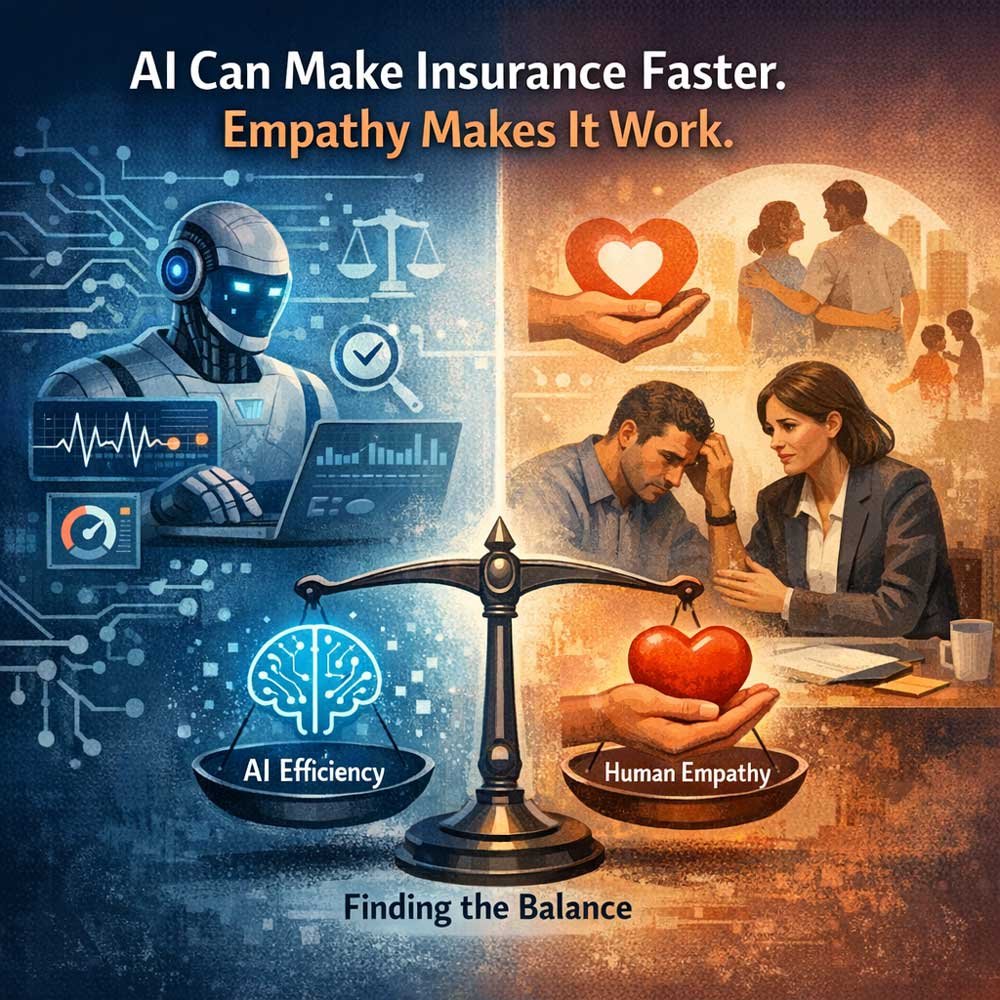
AI can absolutely help. It can shrink cycle times, surface risk signals, and reduce admin drag. But in life and health, the work is not just processing data. It’s guiding people through decisions that touch their body, their family, and their future.
This post is about the balance: AI for efficiency + humans for empathy and judgment—and how to build a practical “hybrid” operating model that doesn’t break trust.
Where AI Is Showing Up Right Now (Life + Health)
1) Underwriting (faster decisions, more data, fewer exams)
Life carriers are using “accelerated” underwriting models that pull from electronic health records (EHRs), prescription history, MIB data, and other sources to speed decisions and reduce invasive requirements. Reinsurers and vendors are also offering platforms that combine real-time data with automated decisioning.
Recent example: John Hancock + Munich Re Life US announced collaboration to improve underwriting automation using Munich Re’s rapid risk assessment platform (alitheia).
John Hancock also launched a GenAI-based underwriting support tool (“Quick Quote”) and reported it supported 20,000+ cases since pilot.
2) Claims processing (automation, routing, fraud detection)
AI is commonly used for:
- extracting data from documents,
- triaging and routing claims,
- flagging potential fraud patterns,
- reducing repetitive manual steps.
Industry discussions highlight the push to use AI to transform underwriting and claims for efficiency and customer experience.
On the health side, the NAIC’s health insurer AI/ML survey report includes usage areas like prior authorization approvals and claims fraud detection.
3) Customer service (virtual assistants + “agent assist” copilots)
In health insurance, AI is increasingly positioned as support for humans, not a full replacement:
- Humana announced “Agent Assist” built with Google Cloud to help member service advocates answer questions more effectively (with language explicitly framing tech as strengthening human connection).
- Aetna has rolled out a conversational AI navigation tool to help members understand and navigate benefits.
- Anthem promotes a Virtual Assistant in its Sydney Health app to guide members through benefits.
The Real Trade-Off: “Fast” vs. “Felt”
AI’s strengths are real. So are its limits.
What AI does best
- Speed & scale: handles high volume 24/7
Pattern detection: finds signals across huge datasets
Consistency: applies rules the same way every time
Admin relief: extracts, summarizes, routes, drafts
What humans do best
Empathy: reading emotion, fear, grief, frustration
Ethical judgment: weighing what’s “allowed” vs. what’s right
Complex decision-making: exceptions, nuance, conflicting inputs
Accountability: a real person can own a decision and explain it
Trust-building: people don’t bond with a model—they bond with care
Here’s the simplest way to think about it:
| What AI Does Best (“Fast”) | What Humans Do Best (“Felt”) |
|---|---|
|
|
Why Human Oversight Isn’t Optional
(Especially in Health)
Health insurance has become the clearest example of what goes wrong when “efficiency” outruns judgment.
There’s active litigation and reporting around alleged algorithm-driven coverage denials and utilization review tools—raising concerns that automated processes can override clinician judgment or create rubber-stamp decisions.
Whether or not every allegation holds, the lesson for any life/health organization is straightforward:
If AI can materially affect access to care or financial security, you need:
- clear boundaries,
- strong governance,
- documented human review,
- and an appeals path that a real person can navigate with the client.
Regulators are pushing in the same direction. The NAIC AI Model Bulletin sets expectations around fairness, accountability, compliance, transparency, and secure/robust systems.
Real-World “Hybrid Wins”
(AI helps… humans still matter)
Hybrid Win #1: Underwriting automation + underwriter expertise
Munich Re describes underwriters and data scientists collaborating to use EHRs and AI tools while maintaining underwriting quality—exactly the hybrid model the industry needs.
Hybrid Win #2: AI as a copilot in the call center
Humana’s “Agent Assist” framing is telling: the tool is positioned to help advocates deliver better answers and more personalized interactions—not to remove the advocate.
Hybrid Win #3: Automated underwriting with human routing for ambiguity
Haven Life described a hybrid approach where algorithms identify ambiguous application data points and route them to an underwriter for judgment—using automation to reduce friction without removing expertise.
A Practical Framework:
The 3-Lane Model for AI in
Life/Health Insurance
Use this to decide when AI runs, when AI assists, and when humans lead.
Lane 1 — Autopilot (AI can run it end-to-end)
Use when the task is:
- repetitive,
- low emotional impact,
- low risk if wrong,
- easy to reverse.
Examples:
- document intake + indexing
- extracting fields from forms
- status updates (“We received your claim”)
- appointment reminders / basic benefit navigation
Non-negotiables: monitoring + auditing + an easy “human” button.
Lane 2 — Copilot (AI drafts, flags, summarizes; humans decide)
Use when decisions are meaningful but structured:
- underwriting triage,
- risk summaries,
- claim routing,
- call center “next best answer,”
- fraud flagging (flag ≠ deny).
Examples:
- AI summarizes an EHR; underwriter signs off
- AI suggests adjudication pathway; claims specialist approves
- AI drafts an explanation letter; human edits for tone + clarity
Lane 3 — Human-Only (AI supports admin, but humans own the call)
Use when:
- stakes are high,
- emotion is high,
- ambiguity is high,
- ethics/fairness risk is high,
- a denial could materially harm someone.
Examples:
- coverage denials / appeals conversations
- complex beneficiary disputes
- sensitive underwriting exceptions
- vulnerable populations / hardship cases
- complaints escalation and remediation
Rule: AI may prepare the file. A human must own the decision and the conversation.
The “Escalation Triggers” Checklist
(When to pull a human in)
If any of these are true, move from Autopilot → Copilot → Human-Only:
- Distress is present: grief, panic, anger, confusion
Decision is irreversible: denial, lapse, rescission, major premium change
Data is messy: conflicting records, missing context, edge cases
Fairness risk: proxy variables, sensitive attributes, disparate impact concerns
Explainability required: “Can we explain this clearly to the customer and regulator?”
Accountability needed: “Who is the named owner of this decision?”
(If you can’t name an owner, your governance is not ready.)
What to Measure So “Efficiency”
Doesn’t Quietly Kill Trust
Don’t just track speed. Track human outcomes:
- Appeal rate + overturn rate
- Complaint volume + themes
- Call transfers and repeat contacts
- Member/customer satisfaction after “high emotion” interactions
- Disparity checks across protected classes (where legally applicable)
- Model drift and error rates over time
This aligns with the direction of regulatory expectations around governance, monitoring, transparency, and accountability.
The Future Belongs to Hybrid Teams
The winning posture in life/health insurance isn’t “AI vs. humans.”
It’s:
- AI as the engine for speed and admin relief
- Humans as the engine for trust, ethics, and judgment
The organizations that win will build hybrid teams where:
- AI handles the repeatable work,
- people handle the meaningful work,
- and the system makes it easy to escalate to a human when it matters.
That’s how you get faster without getting colder.
Need additional assistance, contact us today!